Willa Bennett · 9 October 2026
Uncovering Rare Clay Minerals' Role in Next-Generation Battery Technologies
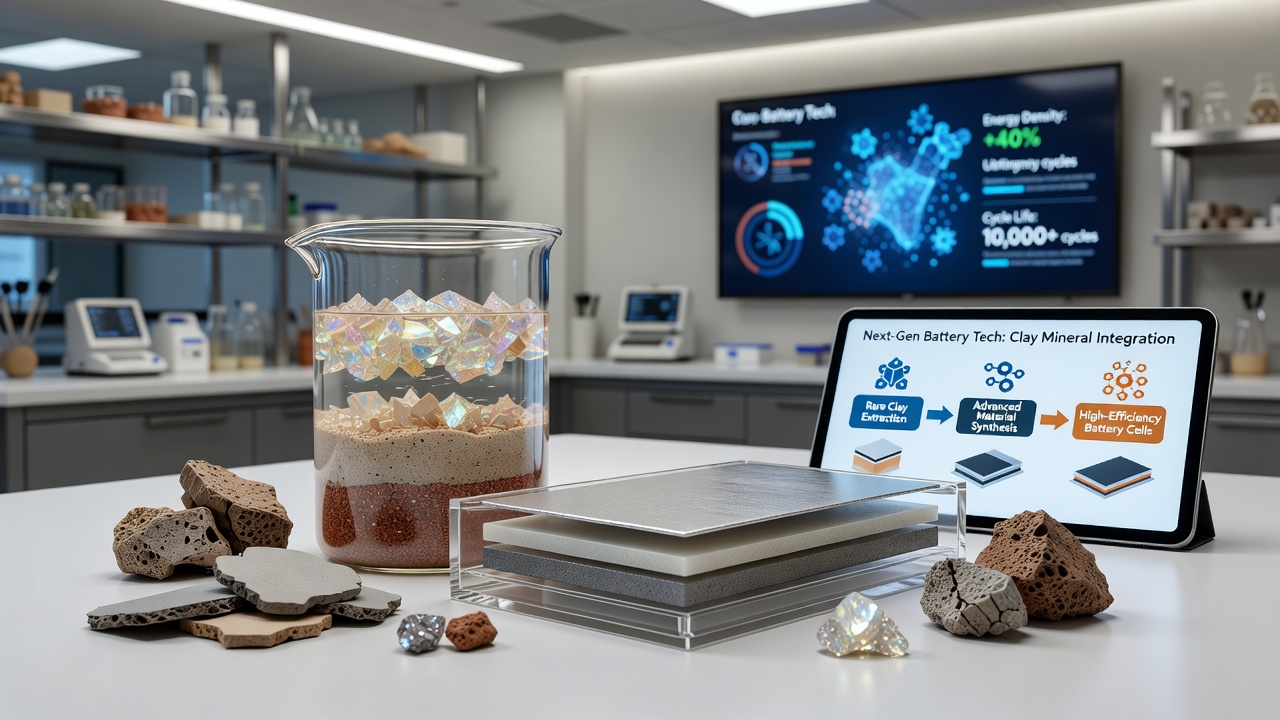
Researchers continue to explore how rare clay minerals contribute to improvements in energy storage systems, particularly as demand grows for more efficient and sustainable battery designs. These naturally occurring materials offer unique layered structures that support ion transport and stability in various battery chemistries, and studies have documented their integration into electrolytes, separators, and electrode formulations over the past decade.
Properties That Enable Battery Applications
Clay minerals such as hectorite and certain smectite variants contain high surface areas along with cation exchange capacities that allow them to interact effectively with lithium ions and other charge carriers. Their ability to form stable gels when combined with polymers creates flexible interfaces that reduce dendrite formation in solid-state configurations, while data from laboratory tests show enhanced cycle life when these minerals appear in composite electrolytes. Observers note that the nanoscale spacing between clay layers provides pathways for ion diffusion without requiring extensive chemical processing, which simplifies manufacturing steps compared to synthetic alternatives.
Integration Into Emerging Battery Chemistries
In sodium-ion and potassium-ion systems, rare clays help address challenges related to larger ion sizes by expanding interlayer distances through controlled hydration. Research teams at institutions across North America and Europe have demonstrated that incorporating small percentages of purified clay into anode slurries improves electronic conductivity and mechanical resilience during repeated charge cycles. Figures from pilot production lines indicate that such additions maintain capacity retention above 85 percent after 500 cycles under standard testing protocols, and similar approaches extend to magnesium-based batteries where traditional liquid electrolytes fall short on safety metrics.
Progress Reported Through Late 2026
By October 2026 multiple collaborative projects had advanced from bench-scale validation to early field trials, with one Australian research consortium reporting successful deployment of clay-enhanced separators in prototype modules for grid storage. Those modules exhibited reduced internal resistance during high-rate discharge, which aligns with findings published in peer-reviewed journals on mineral-binder interactions. Meanwhile, a Canadian government-funded initiative examined supply chain logistics for sourcing specific clay deposits, noting that geological mapping efforts identified viable reserves in sedimentary basins that could support scaled extraction without competing with traditional mining sectors.

European Union research programs have focused on lifecycle assessments, confirming that clay mineral processing generates lower carbon emissions than many metal oxide precursors when purification methods rely on mechanical separation rather than high-temperature calcination. Data compiled through these assessments reveal opportunities for circular approaches, including reclamation of spent battery materials that retain clay fractions for reuse in new cells.
Supply Considerations and Extraction Methods
Extraction of rare clay minerals requires targeted beneficiation techniques that preserve the crystalline structure essential for electrochemical performance. Industry reports highlight solvent-free dispersion methods that achieve high purity levels while minimizing water consumption, and partnerships between academic groups and materials suppliers have refined these processes to meet battery-grade specifications. In regions such as parts of South America and Asia, pilot facilities now operate at capacities sufficient to supply research quantities, with projections indicating commercial volumes could become available within five years if demand continues its upward trajectory.
Technical Challenges Under Active Study
Despite promising results, uniform dispersion of clay particles within electrode matrices remains an area of ongoing refinement because agglomeration can create localized stress points that shorten device lifespan. Scientists address this through surface modification protocols that enhance compatibility with organic binders, and test data show measurable gains in homogeneity when ultrasonic mixing precedes slurry casting. Another focus involves long-term stability under varying humidity conditions, since certain clays exhibit swelling behavior that alters ionic conductivity over time; controlled atmosphere testing protocols developed by international standards bodies help quantify these effects across temperature ranges relevant to automotive and stationary applications.
Conclusion
Continued investigation into rare clay minerals demonstrates their expanding utility across multiple next-generation battery platforms, supported by coordinated efforts from research institutions, government agencies, and industry partners worldwide. As testing protocols mature and supply infrastructure develops, these materials stand positioned to contribute measurable improvements in energy density, safety, and resource efficiency within commercial energy storage solutions.